
Zettar zx set a U.S. national lab's petabyte record — a full petabyte across 5,000 miles in 29 hours, at 96% utilization, encrypted and checksummed. Get instrument and simulation data where it belongs for HPC centers, universities, and national labs — about 10× faster than rsync or Globus, on the DTNs you already run.
Engaged since 2015 on LCLS-II, a U.S. DOE exascale-class project. Winner of the Data Mover Challenge at Supercomputing Asia 2019. The proof is in production, not a slide.
About 10× the throughput of rsync or Globus — line rate, scaling out with no software ceiling. Finally use the network you already pay for.
Standard x86 and ARM servers, Linux, CUBIC as the default congestion control. No exotic hardware, no months of tuning — or take the turnkey appliance.
Move petabytes between institutions and to the cloud. Latency-insensitive — validated over real 5,000- and 12,375-mile transfers, including Poland to Singapore.
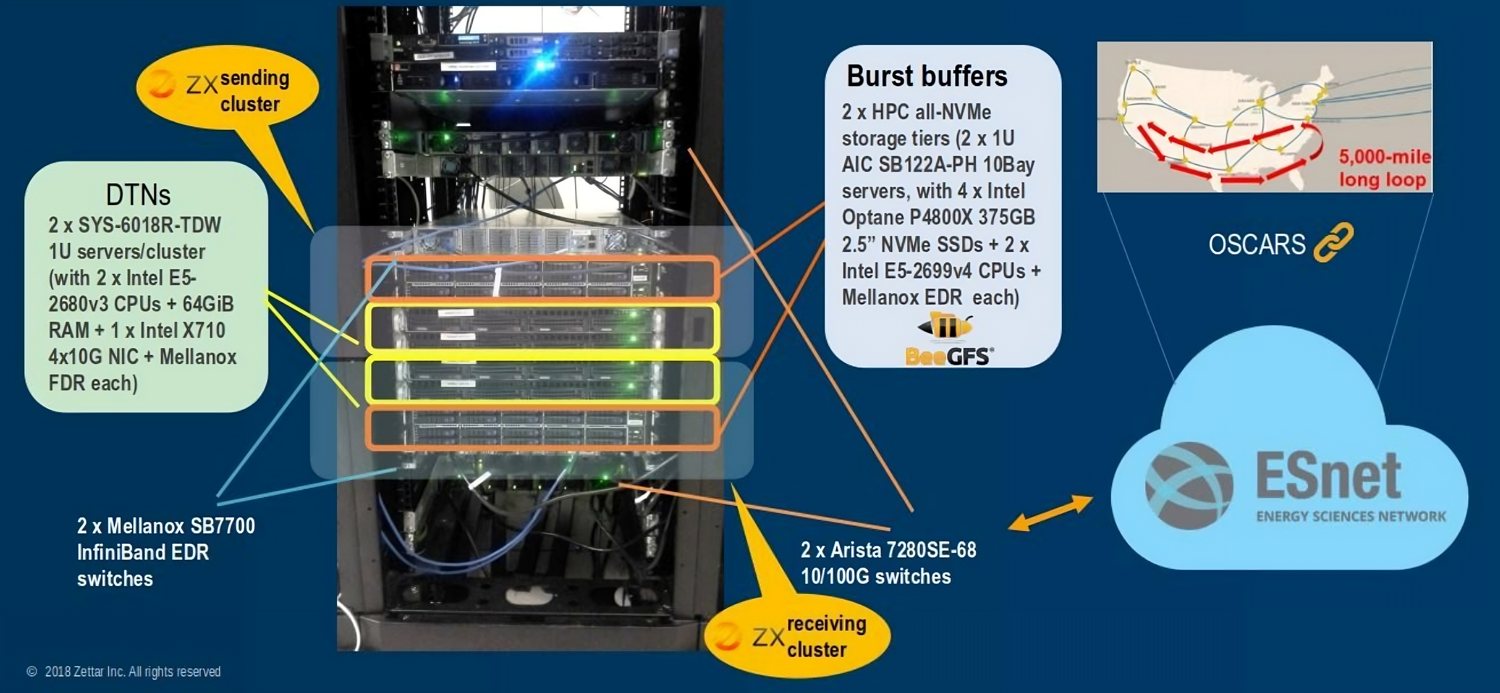
"Zettar moved an actual petabyte over a 5,000-mile network loop in 29 hours — encrypted and checksummed — at 96% bandwidth utilization."
That run was capped at 80 Gbps to spare the shared network — on a full 100 Gbps link, it's a petabyte a day.


"The flexible traffic engineering design of ESnet's network ensures that TCP-based transfer protocols can be used effectively for high-throughput data movement."
The SLAC / ESnet / Zettar system that moved a petabyte in 29 hours over a 5,000-mile loop — sending and receiving zx clusters, NVMe burst buffers, and ESnet's on-demand circuit.
See the zx Appliance move research data at speeds rsync and Globus can't reach.